


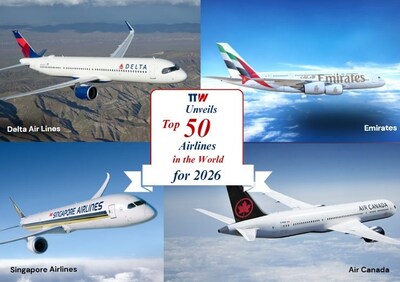
NEW YORK, April 18, 2026 /PRNewswire/ — Travel And Tour World (TTW) announces its comprehensive global aviation research for 2026, presenting the Top 50 Airlines in the World, shaping international travel, connectivity, and passenger mobility. The study highlights a transforming industry where full-service giants and agile low-cost carriers drive innovation through fleet modernisation, premium services, and advanced onboard experiences.
Airlines are now central to global trade, tourism, and economic integration. Passenger traffic is projected to exceed 4.7 billion in 2026, with revenues crossing USD 964 billion, supported by strong long-haul and premium demand. Business and premium economy are expected to generate up to 38% of revenue, while load factors stabilise above 80%.
Fleet upgrades, including over 2,100 new aircraft by 2027, are improving fuel efficiency and sustainability. With alliances controlling over 60% of international traffic and airlines investing heavily in digital and AI-driven systems, the industry is entering a new era of smart, sustainable, and highly connected global aviation growth.
Across continents, leading airlines are driving a new era of aviation connectivity by combining large-scale networks with advanced service models. The rise of premium economy, hybrid service offerings, and long-haul low-cost travel is reshaping how passengers experience air travel. Airlines are increasingly integrating hospitality, technology, and personalization to create differentiated travel experiences.
The findings reveal that airlines are heavily investing in fuel-efficient aircraft such as next-generation Airbus and Boeing models, alongside sustainable aviation fuel (SAF) initiatives and carbon reduction strategies. Industry-wide, aviation is targeting net-zero emissions by 2050, with airlines accelerating efforts toward greener operations.
“The global aviation industry is no longer defined solely by scale, but by intelligence, sustainability, and passenger-centric innovation. Airlines are deploying AI-driven analytics to optimize routes and maintenance, reducing fuel burn by up to 5% and cutting downtime significantly. Sustainability has become a strategic priority.
Although sustainable aviation fuel (SAF) accounts for less than 1% of global usage, airlines worldwide have committed to net-zero emissions by 2050. Meanwhile, premium travel demand is rebounding faster than the economy, and innovations such as biometric boarding are reducing airport processing times by up to 30%”, stated Anup Kumar Keshan, Founder and Editor-in-Chief of Travel And Tour World.
|
Rank |
Airlines |
Headquarters / |
Country |
|
1 |
Delta Air Lines |
Hartsfield–Jackson Atlanta International Airport (ATL) |
United States |
|
2 |
Singapore Airlines |
Singapore Changi Airport (SIN) |
Singapore |
|
3 |
Emirates |
Dubai International Airport (DXB) |
United Arab Emirates |
|
4 |
Air Canada |
Toronto Pearson International Airport (YYZ) |
Canada |
|
5 |
Qatar Airways |
Hamad International Airport (DOH) |
Qatar |
|
6 |
Turkish Airlines |
Istanbul Airport (IST) |
Türkiye |
|
7 |
United Airlines |
Chicago O’Hare International Airport (ORD) |
United States |
|
8 |
Japan Airlines |
Tokyo Haneda Airport (HND) |
Japan |
|
9 |
Lufthansa |
Frankfurt Airport (FRA) |
Germany |
|
10 |
Cathay Pacific |
Hong Kong International Airport (HKG) |
Hong Kong (China) |
|
11 |
American Airlines |
Dallas/Fort Worth International Airport (DFW) |
United States |
|
12 |
Etihad Airways |
Abu Dhabi International Airport (AUH) |
United Arab Emirates |
|
13 |
IndiGo |
Indira Gandhi International Airport (DEL) |
India |
|
14 |
Qantas |
Sydney Kingsford Smith Airport (SYD) |
Australia |
|
15 |
Air France |
Paris Charles de Gaulle Airport (CDG) |
France |
|
16 |
Saudia |
King Abdulaziz International Airport (JED) |
Saudi Arabia |
|
17 |
British Airways |
London Heathrow Airport (LHR) |
United Kingdom |
|
18 |
Korean Air |
Incheon International Airport (ICN) |
South Korea |
|
19 |
All Nippon Airways (ANA) |
Tokyo Haneda Airport (HND) |
Japan |
|
20 |
Aeroflot |
Sheremetyevo International Airport (SVO) |
Russia |
|
21 |
SAS (Scandinavian Airlines) |
Copenhagen Airport (CPH) |
Denmark |
|
22 |
TAP Air Portugal |
Lisbon Humberto Delgado Airport (LIS) |
Portugal |
|
23 |
SWISS International Air Lines |
Zurich Airport (ZRH) |
Switzerland |
|
24 |
Malaysia Airlines |
Kuala Lumpur International Airport (KUL) |
Malaysia |
|
25 |
China Southern Airlines |
Guangzhou Baiyun International Airport (CAN) |
China |
|
26 |
KLM Royal Dutch Airlines |
Amsterdam Schiphol Airport (AMS) |
Netherlands |
|
27 |
Aeroméxico |
Mexico City International Airport (MEX) |
Mexico |
|
28 |
LOT Polish Airlines |
Warsaw Chopin Airport (WAW) |
Poland |
|
29 |
Air China |
Beijing Capital International Airport (PEK) |
China |
|
30 |
AirAsia |
Kuala Lumpur International Airport (KUL) |
Malaysia |
|
31 |
China Airlines |
Taiwan Taoyuan International Airport (TPE) |
Taiwan |
|
32 |
Virgin Atlantic |
London Heathrow Airport (LHR) |
United Kingdom |
|
33 |
EVA Air |
Taiwan Taoyuan International Airport (TPE) |
Taiwan |
|
34 |
Austrian Airlines |
Vienna International Airport (VIE) |
Austria |
|
35 |
Ryanair |
Dublin Airport (DUB) |
Ireland |
|
36 |
Brussels Airlines |
Brussels Airport (BRU) |
Belgium |
|
37 |
Thai Airways |
Suvarnabhumi Airport (BKK) |
Thailand |
|
38 |
China Eastern Airlines |
Shanghai Pudong International Airport (PVG) |
China |
|
39 |
Finnair |
Helsinki Airport (HEL) |
Finland |
|
40 |
LATAM Airlines |
Santiago International Airport (SCL) |
Chile |
|
41 |
Air Astana |
Almaty International Airport (ALA) |
Kazakhstan |
|
42 |
Scoot |
Singapore Changi Airport (SIN) |
Singapore |
|
43 |
Akasa Air |
Chhatrapati Shivaji Maharaj International Airport (BOM) |
India |
|
44 |
Virgin Australia |
Brisbane Airport (BNE) |
Australia |
|
45 |
Philippine Airlines |
Ninoy Aquino International Airport (MNL) |
Philippines |
|
46 |
Ethiopian Airlines |
Addis Ababa Bole International Airport (ADD) |
Ethiopia |
|
47 |
Iberia |
Madrid-Barajas Airport (MAD) |
Spain |
|
48 |
Gol Linhas Aéreas |
São Paulo–Guarulhos International Airport (GRU) |
Brazil |
|
49 |
Aer Lingus |
Dublin Airport (DUB) |
Ireland |
|
50 |
EgyptAir |
Cairo International Airport (CAI) |
Egypt |
Delta Air Lines continues to reinforce its position as a global aviation leader through a powerful blend of network depth, fleet scale, and premium service strategy. The airline dominates key transatlantic and transpacific corridors, with flagship routes such as New York–London, Atlanta–Paris, and Los Angeles–Tokyo driving sustained international demand. Its hub-centric model—anchored at Atlanta, Detroit, Minneapolis, JFK, and Salt Lake City—ensures seamless connectivity across continents.
With a fleet of nearly 1,000 aircraft, including advanced widebodies like the Airbus A350, A330, and Boeing 767, Delta maintains one of the world’s most robust long-haul operations. Looking ahead, the introduction of the A350-1000 and an extensive retrofit programme signal a strong premium push. Delta One suites offer privacy with full doors, while Premium Select enhances mid-tier comfort. Free Wi-Fi expansion and chef-curated, regionally inspired menus further elevate the onboard experience, reinforcing Delta’s premium-first positioning.
Singapore Airlines continues to set global benchmarks in long-haul aviation through its ultra-premium positioning and network strength. Its flagship routes—Singapore to London, New York, and Sydney—anchor one of the most strategic intercontinental networks, including the world’s longest nonstop flight to New York. The airline operates a modern fleet of over 150 aircraft, led by Airbus A350s and iconic A380s. Its innovation roadmap includes the rollout of new ultra-premium suites from 2026, reinforcing its luxury leadership. Cabin offerings remain industry-leading, with Suites Class delivering private rooms, alongside highly regarded business, premium economy, and economy cabins. Connectivity is robust, with complimentary WiFi for premium and loyalty passengers. Catering remains a standout feature through its “Book the Cook” service, allowing passengers to pre-select gourmet meals. Continuous cabin refresh cycles ensure Singapore Airlines remains at the forefront of passenger experience and innovation.
Emirates dominates global aviation through its Dubai mega-hub, connecting over 150 cities across six continents. With a fleet of approximately 263 aircraft, it is the world’s largest Airbus A380 operator, offering unmatched scale in long-haul capacity. The airline is undergoing a significant transformation phase, introducing Airbus A350s while executing a massive retrofit programme for its A380 and Boeing 777 fleet. Emirates’ cabins remain iconic, featuring private First Class suites with shower spas, business class with onboard lounges, and a rapidly expanding premium economy product. Economy cabins are high-density yet modern and comfortable. A major technological leap is underway with Starlink-powered WiFi rolling out fleet-wide. Catering is equally premium, with regionally tailored menus, luxury dining experiences, and high-end beverages, reinforcing Emirates’ strong positioning in the global premium travel segment.
Air Canada plays a crucial role in connecting North America to Europe and Asia through its hubs in Toronto, Vancouver, and Montreal. Its network is particularly strong across transatlantic and transpacific corridors, making it a key global connector. The airline operates a diverse fleet of around 350 aircraft, including Airbus A220s and Boeing 787 Dreamliners, supporting both efficiency and passenger comfort. Cabin segmentation includes Signature Class for business travellers, alongside premium economy and economy cabins. While WiFi services are currently paid or subscription-based, ongoing upgrades are improving speed and reliability. Air Canada’s onboard catering reflects Canadian identity, with regionally inspired cuisine and locally sourced ingredients. The airline continues to refine its premium offerings and digital capabilities, positioning itself as a competitive North American carrier with a strong international footprint.
Qatar Airways remains a global benchmark for premium aviation, leveraging its Doha hub to connect Europe, Asia, and the Americas efficiently. With a fleet of around 250 aircraft, including Airbus A350s and Boeing 777s, the airline maintains a modern and fuel-efficient operation. Its flagship Qsuite business class product continues to redefine luxury with privacy doors and flexible seating configurations. The upcoming Qsuite Next Gen rollout between 2026 and 2027 is expected to further elevate this offering. While premium economy remains limited, economy class maintains high standards of comfort and service. The airline is expanding free Starlink-powered WiFi, enhancing onboard connectivity. Catering is a standout feature, with a dine-on-demand concept and restaurant-quality meals. Qatar Airways’ consistent focus on innovation and luxury cements its reputation as a leader in global premium travel.
Turkish Airlines has built the world’s most extensive global network by serving the highest number of countries, using Istanbul as its strategic mega-hub. Its rapidly expanding fleet of over 400 aircraft supports this ambitious growth, enabling connectivity across Europe, Asia, Africa, and the Americas. The airline offers competitive business class cabins with lie-flat beds and a strong economy product known for comfort and service quality. While WiFi availability varies by aircraft, improvements are ongoing. One of Turkish Airlines’ strongest differentiators is its inflight catering, widely regarded among the best globally, featuring chef-led service and diverse cuisine. The airline continues to expand aggressively, leveraging its geographic advantage and operational scale to position itself as a major global connector with strong service credentials.
United Airlines operates the world’s largest route network, serving over 370 destinations globally, making it a dominant force in international aviation. With a fleet exceeding 1,000 aircraft, it also ranks among the largest airlines by fleet size. United is undergoing a significant premium transformation, with the introduction of Polaris Studio suites expected from 2026. Its Polaris business class, Premium Plus, and economy cabins offer a tiered service approach catering to diverse passenger segments. Connectivity is improving with advanced satellite-based WiFi systems being deployed across the fleet. Catering in premium cabins has also been upgraded, focusing on quality and variety. United’s scale, combined with ongoing investment in product and technology, reinforces its leadership in global aviation while addressing evolving passenger expectations.
Japan Airlines maintains a strong presence on key Asia–US and Asia–Europe routes, particularly Tokyo to New York and London. Its fleet of around 200 aircraft, with a growing emphasis on Airbus A350s, supports both efficiency and premium comfort. The airline has introduced new A350 suites, enhancing its premium offering significantly. Premium economy is particularly well-regarded, offering generous space and upgraded services. WiFi is increasingly available free on many routes, improving passenger experience. Catering is a major highlight, blending traditional Japanese haute cuisine with international dishes, reflecting cultural excellence. Japan Airlines’ focus on precision, service quality, and product refinement ensures it remains a preferred carrier for long-haul travellers seeking reliability and comfort.
Lufthansa anchors Europe’s aviation network through its Frankfurt and Munich hubs, offering extensive connectivity across continents. As part of a larger group with over 700 aircraft, it operates one of the most comprehensive fleets in Europe. The airline is currently rolling out its “Allegris” cabin concept, introducing highly customisable business class seating and redesigned first-class suites. WiFi is widely available across long-haul aircraft, supporting business and leisure travellers alike. Catering focuses on European gourmet cuisine, with regionally inspired menus. Lufthansa’s ongoing investment in cabin innovation and premium services reflects its strategy to remain competitive in the evolving global aviation landscape, particularly against Middle Eastern and Asian carriers.
Cathay Pacific continues to position itself as a premium-focused carrier connecting Asia with North America and beyond. With a fleet of around 200 aircraft, including advanced Airbus A350s, the airline emphasises efficiency and passenger comfort. Its latest innovation, the Aria Suite, marks a significant upgrade in business class, offering enhanced privacy and design. The airline maintains a premium-heavy cabin configuration, while economy class remains comfortable and competitive. WiFi is installed on most long-haul aircraft, ensuring consistent connectivity. Catering is a key strength, featuring Asian fusion cuisine with international influences. Cathay Pacific’s focus on premium service, product innovation, and strategic network positioning reinforces its status as a leading long-haul carrier.
American Airlines stands as one of the most expansive global carriers, leveraging its dominant hubs at Dallas/Fort Worth, Charlotte, Miami, and Chicago O’Hare to sustain a powerful transatlantic and transcontinental network. Key trunk routes such as Dallas–London, Miami–São Paulo, and New York–Los Angeles reinforce its dual strength in business and leisure demand corridors. With a fleet approaching 970 aircraft, it remains among the largest airlines globally, competing directly with United Airlines in scale. The airline is undergoing a premium transformation, highlighted by the phased rollout of Flagship Suites between 2025 and 2027 and the introduction of premium-heavy Boeing 787 configurations. Cabin segmentation is becoming more defined, with enclosed business suites, expanding premium economy, and densified economy cabins. Connectivity is evolving rapidly, with free WiFi emerging for loyalty members. Culinary offerings continue to elevate, especially in premium cabins with multi-course dining and curated beverage programmes.
Etihad Airways is recalibrating its strategy around profitability and premium experience, positioning its Abu Dhabi hub as a high-end transit node linking Europe, Asia, and Australia. Unlike Gulf rivals pursuing aggressive expansion, Etihad has adopted a disciplined fleet and network model centred on approximately 90 aircraft, primarily Airbus A350s and Boeing 787 Dreamliners. The airline’s value proposition lies in luxury differentiation, exemplified by “The Residence,” one of the most exclusive inflight experiences globally. Business Studios and upgraded economy seating maintain a strong product hierarchy. Operational focus between 2025 and 2026 has shifted toward yield optimisation rather than network scale. WiFi remains paid but is improving in speed and consistency, aligning with premium expectations. Catering continues to be a major differentiator, offering à la carte fine dining in premium cabins, reinforcing Etihad’s positioning as a boutique luxury airline rather than a volume-driven global connector.
IndiGo dominates the Indian aviation market with an unmatched domestic network, connecting major corridors such as Delhi–Mumbai and Bengaluru–Kolkata with high-frequency operations. With a fleet exceeding 350 aircraft, it is the largest narrow-body operator in India and among the fastest-growing globally. The airline’s expansion strategy is entering a new phase, with planned entry into long-haul markets from 2026 through widebody leases, marking a structural shift from its traditional low-cost, short-haul model. Currently, IndiGo maintains a single-class economy configuration focused on efficiency and cost leadership, although ancillary-based premium add-ons are gradually emerging. Inflight connectivity remains limited but is expected to develop as the airline modernises its fleet. Catering follows a buy-on-board model, emphasising Indian cuisine and affordability. IndiGo’s evolution signals a transition from a domestic low-cost giant to a hybrid international competitor.
Qantas continues to position itself as a pioneer in ultra-long-haul aviation, with its “Project Sunrise” initiative set to redefine non-stop travel between Australia and Europe. Core routes such as Sydney–London and Melbourne–Los Angeles highlight its long-haul strength, while a fleet of around 300 aircraft supports both domestic and international operations. The introduction of Airbus A350-1000 aircraft for flights exceeding 20 hours marks a major technological and passenger-experience milestone expected between 2026 and 2027. Cabin offerings are premium-heavy, with first-class suites, advanced business suites, and a strong premium economy segment. Domestic WiFi performance is already robust, while international connectivity is expanding progressively. Catering reflects Australian culinary identity, featuring regionally inspired dishes and curated wine pairings. Qantas’ strategy combines technological innovation with national branding to maintain competitiveness in long-haul premium travel.
Air France leverages its Paris hub to function as a central European gateway, connecting global long-haul routes with strong intra-European feed. Operating a fleet of approximately 230 aircraft, the airline is focusing heavily on product refinement and premium positioning. The introduction of its new Business Suite with sliding doors reflects a broader industry trend toward privacy and personalisation. At the top end, La Première remains one of the most exclusive first-class offerings worldwide. Premium economy continues to gain importance as a mid-tier product. Air France is also investing in next-generation high-speed satellite WiFi systems to enhance passenger connectivity. Its catering remains a standout feature, supported by partnerships with Michelin-starred chefs, reinforcing France’s culinary reputation. Overall, Air France blends luxury, heritage, and innovation to maintain a strong foothold in the competitive transatlantic and global aviation market.
Saudia is undergoing a strategic transformation aligned with Saudi Arabia’s broader aviation and tourism ambitions. With hubs in Jeddah and Riyadh, the airline connects the Middle East to Asia, Europe, and Africa through a steadily modernising fleet of around 150 aircraft. The introduction of Boeing 787 Dreamliners is central to its fleet renewal and long-haul competitiveness. Saudia is repositioning itself as a premium carrier, upgrading business class suites and enhancing overall passenger experience. Connectivity is available on widebody aircraft, though not yet fleet-wide. Catering remains a key differentiator, offering halal gourmet meals tailored to regional and international tastes. The airline’s transformation reflects the Kingdom’s Vision 2030 strategy, aiming to elevate service standards and expand global connectivity while maintaining cultural identity and service authenticity.
British Airways operates one of the most influential global networks from its London Heathrow hub, serving as a critical transatlantic and intercontinental gateway. With a fleet of approximately 280 aircraft, the airline is investing heavily in product upgrades, particularly through the rollout of its Club Suite business class with privacy doors. First class remains available on select long-haul routes, while World Traveller Plus continues to strengthen its premium economy offering. WiFi is available across most of the fleet, although speeds and consistency vary depending on aircraft type. Catering reflects British and European culinary traditions, supported by an extensive premium lounge dining experience at Heathrow. British Airways’ strategy centres on premium enhancement and hub dominance, maintaining its relevance in an increasingly competitive long-haul market.
Korean Air utilises Seoul Incheon as a strategic hub linking Asia with North America and Europe. With a fleet of around 160 aircraft, the airline maintains a balanced network across long-haul and regional routes. A major development is its ongoing integration with Asiana Airlines, which is expected to reshape South Korea’s aviation landscape. Cabin offerings include Prestige Business Class and economy seating designed for long-haul comfort. WiFi rollout is progressing across the long-haul fleet, enhancing passenger connectivity. Catering is a strong differentiator, combining traditional Korean cuisine with international meal options. Korean Air’s strategic consolidation and service consistency position it as a key player in Northeast Asia’s competitive aviation market.
All Nippon Airways (ANA) is widely recognised for product innovation and service quality, operating from its Tokyo hub with strong connectivity to North America and Europe. With a fleet of approximately 240 aircraft, ANA balances efficiency with premium service excellence. Its “The Room” business class is among the widest in the industry, redefining passenger comfort standards. First class and premium economy offerings further strengthen its premium positioning. WiFi is increasingly available free of charge on select long-haul routes, aligning with evolving passenger expectations. Catering is a core strength, featuring high-end Japanese kaiseki dining alongside international options. ANA’s approach combines cultural authenticity with technological innovation, making it one of the most respected carriers globally.
Aeroflot historically operated as a major connector between Europe and Asia through its Moscow hub, supported by a fleet of around 180 aircraft. However, ongoing geopolitical restrictions have significantly constrained its international operations, forcing a shift toward domestic and limited regional services. Cabin offerings include business and economy classes, though product development has slowed under current conditions. WiFi availability remains limited across the fleet. Catering traditionally blends Russian and European influences, maintaining a distinct cultural identity. Despite operational challenges, Aeroflot retains structural importance within Russia’s aviation ecosystem. Its future trajectory will largely depend on geopolitical developments and the potential reopening of international airspace access.
Scandinavian Airlines (SAS) operates a strategically positioned network linking Copenhagen, Stockholm, and Oslo with key European and transatlantic markets, including high-demand routes such as Copenhagen–New York and Stockholm–London. With a fleet of around 130 aircraft, largely composed of Airbus A320neo family jets and A330/A350 widebodies, SAS balances efficiency with long-haul capability. Between 2025 and 2026, the airline is undergoing a structural transformation, marked by its transition into the SkyTeam alliance and a strong emphasis on cost restructuring and sustainability. Cabin offerings include lie-flat business class on long-haul, premium economy, and standard economy. Connectivity is robust across European flights, while long-haul satellite WiFi is being progressively deployed. Catering highlights Nordic cuisine with a strong sustainability ethos, reinforcing SAS’s identity as an environmentally conscious full-service carrier.
TAP Air Portugal leverages its Lisbon hub as a vital bridge between Europe, Brazil, and Africa, with flagship routes such as Lisbon–São Paulo and Lisbon–Luanda forming the backbone of its long-haul network. Operating a fleet of around 100 aircraft, primarily Airbus A320neo and A330neo models, TAP has positioned itself as a transatlantic specialist with a clear focus on Brazil-Europe connectivity. Its growth strategy centres on expanding long-haul services while strengthening its niche in Lusophone markets. Cabin products include fully flat business class seats and competitively configured economy cabins. WiFi is available on most long-haul aircraft, supporting passenger expectations for connectivity. Catering is a distinctive strength, showcasing Portuguese cuisine alongside a curated wine programme, reinforcing national identity while enhancing the onboard experience. TAP’s model blends regional expertise with long-haul ambition.
SWISS International Air Lines operates from its Zurich hub, offering seamless connectivity between Europe, North America, and Asia. With a fleet of approximately 90 aircraft, including Airbus A220, A320 family jets, and Boeing 777s, the airline maintains a premium-focused approach within a relatively compact network. A major upcoming development is the “SWISS Senses” cabin programme, scheduled for rollout in 2026, aimed at enhancing passenger comfort and sensory experience across all classes. SWISS offers a full cabin spectrum, including First Class, Business, Premium Economy, and Economy. WiFi is installed across the long-haul fleet, supporting modern travel needs. Catering reflects Swiss precision and quality, featuring premium gastronomy and regionally inspired menus. The airline’s strategy emphasises consistency, premium service, and attention to detail, positioning it as a boutique luxury carrier within the European aviation landscape.
Malaysia Airlines operates from Kuala Lumpur, connecting Southeast Asia with Australia, Europe, and key regional markets. With a fleet of around 80 aircraft, including Airbus A350 and A330 widebodies, the airline is focused on rebuilding and modernising its operations following previous restructuring phases. Current efforts centre on fleet renewal and network optimisation to restore long-haul competitiveness. Cabin offerings include upgraded business suites and modernised economy seating designed to enhance passenger comfort. WiFi is available on selected long-haul aircraft, though not yet across the entire fleet. Catering remains a standout feature, highlighting rich Asian culinary traditions with a focus on Malaysian flavours. Malaysia Airlines aims to strengthen its global presence by combining service quality with operational efficiency, gradually reclaiming its position as a leading Southeast Asian carrier.
China Southern Airlines is one of Asia’s largest carriers, operating from its Guangzhou hub with an extensive domestic and international network. With a fleet of approximately 650 aircraft, it ranks among the largest airlines globally, offering massive capacity across short-haul and long-haul markets. The airline is actively expanding its intercontinental footprint, particularly towards Europe and North America, as part of its long-haul growth strategy. Cabin configurations include business class suites and high-density economy seating to accommodate large passenger volumes. WiFi availability remains limited but is gradually expanding across the fleet. Catering focuses on Chinese regional cuisine, providing a culturally authentic inflight experience. China Southern’s scale, combined with its expanding global ambitions, positions it as a major force in international aviation, particularly within Asia-Pacific markets.
KLM Royal Dutch Airlines operates from its Amsterdam hub, serving as a key European gateway with strong intercontinental connectivity. With a fleet of around 120 aircraft, including Boeing 787s, 777s, and Airbus A320 family jets, KLM balances network breadth with operational efficiency. The airline is recognised for its leadership in sustainability, investing in fuel-efficient aircraft and environmentally conscious practices. Cabin offerings include World Business Class, the newly introduced Premium Comfort (premium economy), and standard economy. WiFi rollout is progressing across the fleet, enhancing passenger connectivity on both short-haul and long-haul routes. Catering combines Dutch culinary influences with international options, delivering a refined yet accessible onboard experience. KLM’s strategy integrates sustainability, innovation, and customer experience, ensuring its continued relevance in the competitive European aviation market.
Aeroméxico operates from Mexico City, connecting Latin America with the United States and Europe through a growing transborder network. With a fleet of around 120 aircraft, primarily Boeing models, the airline emphasises efficiency and long-haul capability, particularly through its Boeing 787 Dreamliner operations. Strong demand in US–Mexico routes continues to drive its growth strategy. Cabin offerings include business class on long-haul flights and standard economy seating. WiFi is installed on most long-haul aircraft, supporting modern passenger expectations. Catering highlights Mexican culinary traditions, complemented by premium tequila and wine selections, adding cultural depth to the inflight experience. Aeroméxico’s positioning as a key Latin American connector is reinforced by its network strength and focus on cross-border travel demand.
LOT Polish Airlines utilises its Warsaw hub to connect Central and Eastern Europe with North America and Asia. With a fleet of around 80 aircraft, including a strong Boeing 787 backbone, LOT has carved out a niche as a transatlantic connector. The airline is actively expanding its North American network, aiming to capture growing demand from Central Europe. Cabin offerings include business class with flat-bed seats and standard economy cabins. WiFi availability remains limited but is gradually expanding as part of fleet upgrades. Catering reflects European cuisine with Polish influences, offering a regional touch to the onboard experience. LOT’s strategy focuses on geographic advantage, connecting underserved markets with major global destinations while maintaining operational efficiency.
Air China operates from its Beijing hub, providing extensive domestic and international connectivity across Asia, Europe, and North America. With a fleet of approximately 480 aircraft, the airline plays a central role in China’s aviation ecosystem. Current developments include fleet modernisation and expansion of intercontinental routes to strengthen its global reach. Cabin offerings span First Class, Business, and Economy, catering to a wide range of passengers. WiFi remains limited but is gradually being introduced across newer aircraft. Catering combines traditional Chinese cuisine with international meal options, ensuring broad appeal. Air China’s strategic importance lies in its scale, government backing, and role as a primary gateway carrier, positioning it as a key player in global aviation.
AirAsia operates one of the largest low-cost networks in Asia, with Kuala Lumpur as its primary hub. With a fleet exceeding 200 Airbus A320 family aircraft, the airline specialises in high-frequency short-haul routes across Southeast Asia and beyond. Its ultra-low-cost carrier (ULCC) model focuses on affordability, efficiency, and ancillary revenue generation. Cabin configurations are primarily economy-only, although AirAsia X offers premium flatbed seating on long-haul services. WiFi availability is limited, reflecting its cost-focused approach. Catering follows a buy-on-board model, featuring a variety of Asian meals tailored to regional tastes. AirAsia’s success lies in its ability to stimulate demand through low fares, making air travel accessible to a broader population while maintaining a strong regional presence.
China Airlines operates a strong transpacific network from its hub at Taiwan Taoyuan International Airport, connecting Taipei with major global cities such as Los Angeles, New York, and Tokyo. With a fleet of around 90 aircraft, including Airbus A350 and Boeing 777 models, the airline is focused on premium long-haul growth. A key development is its order for Airbus A350-1000 aircraft, signalling a push toward enhanced long-haul capacity and premium service. Cabin offerings include premium business class suites, premium economy, and standard economy, catering to diverse passenger segments. WiFi is widely available on long-haul routes, supporting connectivity expectations. Catering combines Taiwanese cuisine with global dining options, creating a balanced onboard experience. China Airlines continues to strengthen its position as a major Asia–North America connector through strategic expansion and product upgrades.
Virgin Atlantic focuses heavily on premium transatlantic travel, operating flagship routes such as London–New York, London–Los Angeles, and London–Delhi from its Heathrow hub. With a fleet of approximately 45 aircraft, including Airbus A350, Boeing 787, and A330neo models, the airline emphasises efficiency and premium experience. Its strategic partnerships with Delta Air Lines and the Air France-KLM group strengthen its global reach. Expansion into Asia, including South Korea in 2026, reflects a diversification beyond traditional transatlantic markets. Cabin products include Upper Class business suites, premium economy, and economy seating. WiFi is available fleet-wide, ensuring consistent connectivity. Catering highlights modern British cuisine, complemented by an onboard cocktail bar concept. Virgin Atlantic’s identity is built on innovation, premium service, and a distinctive brand experience.
EVA Air is a leading Asia–US connector, operating from Taipei Taoyuan Airport with key routes to Los Angeles, Chicago, and New York. With a fleet of around 87 aircraft and significant expansion orders for Airbus A350-1000 and Boeing 787 models, the airline is preparing for long-term growth between 2025 and 2030. EVA Air is globally recognised for its Royal Laurel Business Class, considered among the best in the industry. It also pioneered the premium economy concept, maintaining a strong presence in this segment. WiFi is available across its long-haul fleet, ensuring connectivity for international travellers. Catering combines high-quality Asian and Western cuisine, contributing to its strong reputation. EVA Air’s consistent focus on service excellence and innovation reinforces its competitive position in global aviation.
Austrian Airlines operates from Vienna, serving as a key hub connecting Central and Eastern Europe with long-haul destinations. With a fleet of around 70 aircraft, including Boeing 767, 777, and Airbus A320 family jets, the airline maintains a balanced network structure. Integration within the Lufthansa Group is driving product upgrades and operational alignment. Fleet modernisation is ongoing, with a focus on improving efficiency and passenger experience. Cabin offerings include business class, premium economy, and economy. WiFi expansion is part of the broader Lufthansa Group initiative, including future free connectivity plans. Catering is a defining feature, offering Viennese coffeehouse-style service onboard. Austrian Airlines combines regional connectivity with premium European service standards
Ryanair is Europe’s largest airline by passenger volume, operating a vast network across the continent with routes such as Dublin–London, Barcelona–Rome, and Milan–Berlin. Its multi-base operational model allows high-frequency services and rapid aircraft utilisation. With a fleet of around 648 aircraft, including a growing number of Boeing 737 MAX jets, Ryanair maintains the largest low-cost fleet globally. The airline’s strategy focuses on ultra-low fares supported by high-density seating and ancillary revenue streams. Cabin configuration is economy-only, with optional priority seating upgrades. WiFi remains limited, reflecting its cost-driven approach. Catering follows a buy-on-board model with budget-friendly options. Ryanair’s scale, efficiency, and aggressive pricing strategy continue to dominate the European low-cost aviation market.
Brussels Airlines operates from its Brussels hub, with a distinctive focus on connecting Europe with Africa, a key strength in its network. With a fleet of around 46 Airbus aircraft, the airline maintains a streamlined and efficient operation. As part of the Lufthansa Group, it benefits from integrated strategies and shared resources. Expansion of African routes remains a core priority, reinforcing its niche positioning. Cabin offerings include business class on long-haul flights and economy across all routes. WiFi rollout is expected under Lufthansa Group’s broader connectivity initiatives, including future free access. Catering combines Belgian cuisine with region-specific offerings on African routes. Brussels Airlines continues to build its identity as a specialist Europe–Africa connector.
Thai Airways operates from Bangkok as a major hub linking Asia, Europe, and Australia. With a fleet of around 70 aircraft and a structured expansion pipeline, the airline is undergoing significant restructuring to regain competitiveness. Fleet modernisation includes the introduction of Airbus A321neo aircraft with enhanced business class seats and onboard WiFi, expected from 2026. Cabin offerings include lie-flat business class and economy seating, reflecting a full-service model. WiFi is being expanded across the fleet to improve passenger connectivity. Catering remains a standout feature, showcasing Thailand’s globally recognised culinary heritage. Thai Airways’ transformation strategy focuses on operational efficiency, product improvement, and network optimisation, aiming to restore its position as a leading Asian carrier.
China Eastern Airlines operates from Shanghai, serving as a major hub connecting Asia with Europe and the Americas. With a fleet exceeding 600 aircraft, it is one of the largest airlines globally. The airline is actively expanding its long-haul network, introducing routes such as Shanghai–Zurich, Stockholm, and Vienna, while exploring connections to Latin America. Cabin offerings include first class, business, and economy, catering to a broad passenger base. A major development is the rollout of free WiFi across the fleet by 2026, enhancing passenger experience. Catering combines Chinese cuisine with international options, ensuring wide appeal. China Eastern’s scale and expansion strategy position it as a major global competitor, particularly in long-haul markets.
Finnair operates from Helsinki, historically optimised for Europe–Asia connectivity through efficient northern routing. With a fleet of around 53 Airbus aircraft, the airline maintains a streamlined and modern operation. Recent geopolitical changes have forced a strategic pivot away from Asia, with increased focus on Europe and North America. Cabin offerings include modern business class suites, premium economy, and economy seating. WiFi is available on long-haul aircraft, ensuring connectivity for international travellers. Catering reflects Nordic cuisine with a strong emphasis on sustainability and locally sourced ingredients. Finnair’s adaptability and operational efficiency allow it to navigate changing global conditions while maintaining a premium service standard.
LATAM Airlines is the largest airline group in Latin America, operating major hubs in Santiago, São Paulo, and Lima. With a fleet of around 320 aircraft, the group offers extensive connectivity across the Americas, Europe, and beyond. Key routes include Santiago–Miami, São Paulo–Madrid, and Lima–Los Angeles, reflecting strong long-haul demand. LATAM’s strategy combines passenger and cargo operations, creating a diversified revenue model. Cabin offerings include premium business class, premium economy on short-haul routes, and standard economy. WiFi is being expanded across the fleet to enhance passenger experience. Catering highlights Latin American cuisine with premium enhancements in business class. LATAM’s scale and hybrid model position it as a dominant force in the region’s aviation sector.
Air Astana, the flag carrier of Kazakhstan, has rapidly evolved into a key Eurasian aviation connector linking Europe and Asia. Operating a modern fleet of around 62 aircraft, including Airbus A320neo family jets and Boeing 767s, the airline is undergoing major expansion with new Airbus orders and Boeing 787 Dreamliners set to enter service from 2026. Its primary hubs in Almaty and Astana support a growing network of over 60 destinations across Europe, the Middle East, and Asia. Popular routes include connections from Almaty to London, Istanbul, Bangkok, and Delhi, positioning Kazakhstan as a strategic transit bridge. Air Astana offers a hybrid service model with business and economy cabins, onboard WiFi upgrades, and culturally inspired catering. This expansion reflects Kazakhstan’s ambition to become a major global aviation hub.
Scoot, the low-cost long-haul arm of Singapore Airlines, operates from Singapore as a hybrid budget carrier targeting intercontinental leisure markets. Its network spans key routes such as Singapore–Athens and Singapore–Sydney, reflecting a deliberate expansion into Europe and Australia. With a fleet of around 50 aircraft, primarily Boeing 787 Dreamliners, Scoot leverages fuel efficiency to sustain long-haul low-cost operations. The airline’s hybrid model blends affordability with selective premium features, including ScootPlus seating that offers enhanced comfort similar to premium economy. Connectivity is available as a paid service on Dreamliners, aligning with its ancillary revenue strategy. Catering is pre-order based, offering a mix of Asian and Western meals. Scoot’s positioning focuses on cost-conscious long-haul travellers, effectively bridging the gap between traditional low-cost carriers and full-service airlines.
Akasa Air is emerging as one of India’s fastest-growing airlines, focusing on high-demand metro-to-tier-2 city connectivity. Operating from hubs in Mumbai and Bengaluru, the airline currently maintains a fleet of around 25 aircraft but holds an aggressive order book exceeding 200 Boeing 737 MAX jets. Its strategy combines an ultra-low-cost structure with selective premium service elements, aiming to differentiate within India’s competitive aviation market. Cabin offerings include standard economy seating alongside extra legroom options, appealing to value-conscious yet comfort-seeking passengers. WiFi services are planned as the fleet expands, signalling a future-ready approach. Catering follows a buy-on-board model with Indian-focused menus tailored to domestic preferences. Akasa Air’s rapid expansion and hybrid service positioning indicate its ambition to become a major player in India’s evolving aviation ecosystem.
Virgin Australia operates as a major domestic carrier, connecting key cities such as Sydney, Melbourne, Brisbane, and Perth. With a fleet of around 100 aircraft, primarily Boeing 737s, the airline has transitioned from a full-service model to a hybrid structure following its restructuring phase. The strategic focus is now on profitability and streamlined operations while retaining key premium offerings. Cabin configurations include business class and economy, catering to both corporate and leisure travellers. WiFi is widely available on domestic routes, enhancing passenger connectivity. Catering reflects the hybrid model, with complimentary snacks in economy and more extensive meal options in business class. Virgin Australia’s repositioning highlights a balanced approach between cost efficiency and service quality, allowing it to remain competitive in Australia’s domestic aviation market.
Philippine Airlines operates from Manila as a key connector between Southeast Asia, North America, and the Middle East. With a fleet of approximately 80 aircraft, including Airbus A350 and A321 models, the airline is focused on expanding its long-haul presence, particularly in North America. Fleet modernisation remains central to its strategy, enhancing both efficiency and passenger experience. Cabin offerings include business class, premium economy, and standard economy, providing a full-service product range. WiFi is available on long-haul aircraft, supporting connectivity needs for international travellers. Catering blends Filipino cuisine with international dishes, offering a culturally rich onboard experience. Philippine Airlines’ growth trajectory is anchored in diaspora travel demand and increasing transpacific connectivity.
Ethiopian Airlines is Africa’s largest and most expansive carrier, operating from its Addis Ababa hub with connections to over 120 global destinations. With a fleet of around 140 aircraft, including Boeing 787 and Airbus A350 jets, the airline is a dominant force in Africa-Europe-Asia connectivity. Its growth strategy is characterised by aggressive network expansion and strategic partnerships, positioning Addis Ababa as a major global transit hub. Cabin offerings include Cloud Nine business class and economy, delivering a balanced service model. WiFi is available on modern widebody aircraft, enhancing long-haul travel experience. Catering features a mix of African and international cuisine, reflecting the airline’s cultural identity. Ethiopian Airlines continues to set the benchmark for aviation growth and connectivity across the African continent.
Iberia operates from Madrid as a primary gateway between Europe and Latin America, leveraging strong cultural and economic ties. With a fleet of around 160 aircraft, the airline is focused on expanding its presence in Latin American markets while modernising its fleet. Cabin offerings include Business Plus, premium economy, and economy, catering to a wide range of passengers. WiFi is installed across long-haul aircraft, supporting passenger connectivity. Catering highlights Spanish cuisine, complemented by premium wine selections that enhance the onboard experience. Iberia’s strategy centres on strengthening its transatlantic network and maintaining Madrid’s position as a leading hub for Europe–Latin America travel. Its consistent focus on service quality and regional expertise ensures its continued competitiveness.
Gol Linhas Aéreas is Brazil’s largest domestic airline, operating an extensive network across the country and into regional South American markets. With a fleet of around 140 Boeing 737 aircraft, Gol emphasises operational simplicity and efficiency. Its business model blends low-cost principles with selective premium features, appealing to a broad passenger base. Cabin offerings are primarily economy, with premium seating options available for added comfort. The airline was among the first in Latin America to introduce onboard WiFi, setting a benchmark for regional connectivity. Catering follows a buy-on-board model, offering snacks and meals tailored to local preferences. Gol’s focus on domestic dominance and regional expansion positions it as a key player in South America’s aviation landscape.
Aer Lingus operates from Dublin, connecting Ireland with Europe and North America through a growing transatlantic network. With a fleet of around 70 aircraft, including Airbus A320, A330, and A321LR models, the airline is at the forefront of narrowbody long-haul innovation. Its strategy focuses on expanding transatlantic routes while maintaining strong European connectivity. Cabin offerings include business class on long-haul flights and economy across all routes. WiFi is available on long-haul aircraft, supporting passenger expectations. Catering reflects Irish culinary traditions, enhanced by premium offerings in business class. Aer Lingus continues to strengthen its position as a key transatlantic carrier, leveraging Dublin’s geographic advantage for efficient US-Europe connectivity.
EgyptAir operates from Cairo as a strategic hub connecting Africa, the Middle East, and Europe. With a fleet of around 80 aircraft, the airline is undergoing fleet renewal with the introduction of Boeing 787 Dreamliners, enhancing long-haul capabilities. Its strategy focuses on strengthening Cairo’s position as a regional transit hub while expanding connectivity across key markets. Cabin offerings include business class and economy, maintaining a traditional full-service model. WiFi is available on select aircraft, with gradual expansion expected. Catering combines Middle Eastern and international cuisine, delivering a diverse onboard experience. EgyptAir’s role as a regional connector remains vital, supported by its geographic positioning and ongoing modernisation efforts.
“As global connectivity accelerates toward record demand levels, aviation is emerging as a powerful engine of economic growth and mobility. The transformation we are witnessing today reflects a decisive shift toward greener fleets, strategic alliances, and value-driven travel ecosystems that are reshaping the future of global tourism and trade.” added Anup Kumar Keshan, Founder and Editor-in-Chief, Travel And Tour World.
Earlier, Travel And Tour World has published TTW Reveals Top 100 Convention Centers in the World for 2026, Top 20 Safest Travel Destinations in the Americas and Caribbean for 2026, TTW Reveals Top 50 Safest Travel Destinations Around the World for 2026, TTW Picks Best 50 Heritage Travel Destinations in the World for 2026, TTW Reveals 50 Best Nightlife Travel Destinations in the Americas and Caribbean for 2026, TTW Announces Top 50 Nightlife Travel Destinations in the World for 2026, Top 50 Cruise Ships Around the World for 2026 Revealed by TTW, Top 50 Valentine’s Day Travel Destinations in Americas and Caribbean Unveiled by TTW, 50 Best Valentine’s Day Travel Destinations Around the World, Top 50 Countries of the World as Best Travel Destinations for 2026, Top 50 Destinations Around the World for US Travelers in 2026 and Top 50 Adventure Travel Destinations of the World for 2026.
The methodology for this study on the Top 50 Airlines in the World for 2026 follows a multi-dimensional approach, combining quantitative performance metrics with qualitative industry insights. The research integrates extensive secondary data analysis, global benchmarking, and a detailed evaluation of airline operations, service standards, and strategic positioning within the international aviation ecosystem.
This study uses a descriptive, comparative, and evaluative design to assess and rank airlines based on passenger experience, operational efficiency, connectivity, and sustainability. It also examines fleet modernization, technology adoption, and service models across full-service, low-cost, and hybrid carriers, while evaluating each airline’s strategic role in regional and global aviation networks.
The study uses data from airline reports, industry publications, aviation bodies, and financial disclosures. It covers 50 major airlines worldwide and evaluates them on fleet size, passenger traffic, route networks, service quality, and operational reliability for a comprehensive global analysis.
The research utilizes a consistent set of evaluation metrics to rank the airlines. The key parameters include:
- Passenger Comfort & Cabin Experience: Seating quality, in-flight entertainment, onboard services, and premium cabin offerings.
- Fuel Efficiency & Sustainability: Fleet age, adoption of fuel-efficient aircraft, sustainable aviation fuel initiatives, and carbon reduction strategies.
- Technological Innovation: Use of digital platforms, AI-driven operations, onboard connectivity, and advanced avionics.
- Operational Performance & Reliability: On-time performance, flight frequency, network efficiency, and operational resilience.
- Safety Record & Engineering Excellence: Compliance with international aviation safety standards and maintenance quality.
- Airline Adoption & Global Popularity: Passenger traffic, market share, and global brand recognition.
- Passenger Appeal & Market Perception: Customer satisfaction, brand loyalty, and service reputation.
- Network Strength: Global route coverage, hub connectivity, and alliance partnerships.
- Cost Efficiency for Airlines: Operational cost management, fleet optimization, and revenue models.
- TTW Reader’s Choice: Rankings reflect TTW readers choice and editorial team selection
A comparative benchmarking methodology has been applied to evaluate airlines across regions and business models. Each airline has been analyzed against global peers using standardized metrics to ensure consistency and fairness.
Key trends identified include:
- Regional Leadership: North American carriers such as United Airlines, Delta Air Lines, and American Airlines dominate in scale and network strength.
- Premium Excellence: Middle Eastern and Asian carriers like Qatar Airways, Emirates, and Singapore Airlines lead in service quality and long-haul innovation.
- Rise of Low-Cost Carriers: Airlines such as Ryanair, easyJet, and IndiGo are reshaping global travel with cost-efficient and high-frequency operations.
- Sustainability Focus: A growing number of airlines are investing in fuel-efficient fleets and targeting net-zero emissions, aligning with global aviation goals.
- Emerging Market Growth: Airlines from Asia-Pacific, Latin America, and Africa are gaining prominence due to rising passenger demand and expanding connectivity.
Detailed case studies of select airlines provide deeper insights into operational strategies and market leadership. Notable examples include:
- United Airlines (USA): A global leader in network scale and fleet modernization, driving connectivity across major international markets.
- Qatar Airways (Qatar): Renowned for premium service excellence, innovation, and strong long-haul connectivity.
- Singapore Airlines (Singapore): A benchmark in passenger experience, technological innovation, and operational efficiency.
- IndiGo (India): A leader in low-cost efficiency with high aircraft utilization and strong domestic dominance.
- Emirates (UAE): A global aviation powerhouse known for luxury, connectivity, and wide-body fleet strength.
Data accuracy is ensured through cross-verification with authoritative aviation sources and industry benchmarks. A uniform set of evaluation criteria is applied across all airlines to maintain consistency, strengthening the reliability of rankings and supporting robust analysis of global aviation trends and competitiveness.
Travel and Tour World (TTW) is a premier global digital travel media platform reaching over 25 million readers worldwide across 104 regional platforms in European, Asian, African, Middle East and Indian languages. Since 2009, TTW has been a trusted source of travel and tourism industry news, intelligence, and trend analysis. Through insightful content, reliable information, and effective communication, TTW delivers valuable perspectives that support informed decision-making and inspire modern travellers worldwide. Built on years of industry expertise, the platform has evolved into a trusted source for comprehensive travel and tourism insights.
As an official media partner to more than 1,500 international travel and hospitality events, including WTM Events, ITB Asia, ITB China, IMEX America & Frankfurt, and ATM, TTW connects tourism boards, airlines, hotels, tour operators, MICE planners, and luxury travel brands with global industry decision-makers. With its unmatched multilingual reach and editorial credibility, TTW continues to shape conversations that define the future of global travel.
Media Contact:
Tuhin Sarkar
+1 917-677-7753
Travel and Tour World
pr@travelandtourworld.com

 View original content to download multimedia:https://www.prnewswire.com/news-releases/ttw-unveils-top-50-airlines-in-the-world-for-2026-302746561.html
SOURCE Travel And Tour World
 Disclaimer: The above press release comes to you under an arrangement with PR Newswire. We takes no editorial responsibility for the same.