
Fragmenting Mobile Behavior Creates Widening Gaps in Verified US App Measurement, RealityMine® Data Shows


New findings reveal an “Attention Paradox” as consumers concentrate time in top platforms yet embracing a widening ecosystem; AI app usage growing exponentially
MANCHESTER, England, May 7, 2026 /PRNewswire/ — U.S. mobile behavior is becoming harder to track—and even harder to predict. New Q1 2026 data from RealityMine® shows that while consumer attention remains heavily concentrated within a handful of dominant platforms, overall behavior is rapidly fragmenting across an expanding ecosystem of apps— an “Attention Paradox” that is creating new measurement challenges for marketers, platforms and AI systems.
The Rise of the Micro-Moment Economy
RealityMine’s in-app and cross-app behavioral data shows that mobile engagement is now defined by constant, short bursts of activity. The typical U.S. consumer uses approximately 19 apps per day and interacts with their device 90 to 200 times daily, with most interactions lasting just 14 to 90 seconds.
This shift toward high-frequency, short-duration engagement signals the emergence of a micro-moment economy, where attention is continuous but fleeting—forcing brands and advertisers to compete not for minutes, but for seconds As a result, the need for precise, verified data on what consumers are actually doing within and across apps continues to grow.
Attention Remains Highly Concentrated
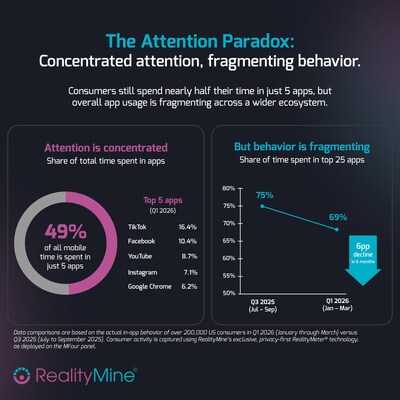
Despite increasing fragmentation, attention continues to consolidate among a small group of dominant platforms. Nearly 49% of all mobile time is spent within just five apps: TikTok, Facebook, YouTube, Instagram, and Google Chrome.
Expanding to the top 25 apps captures 69% of total time spent, spanning social media, search, streaming, messaging, and gaming. However, this concentration masks a deeper shift: the share of time spent within the top 25 apps has declined from 75% to 69% over the past six months.
This suggests a structural change in consumer behavior—one where users continue to rely on core platforms while increasingly exploring a broader “long tail” of apps. For marketers, this creates growing blind spots, as significant portions of consumer activity occur outside easily measurable environments.
A More Dynamic and Less Visible Ecosystem
As consumers diversify their app usage, a growing share of engagement is taking place across smaller, niche, and emerging platforms—making the limitations of pure first party data more pronounced. App owners need measurement that follows consumers across the app universe, whether they are using 2 apps or 20.
This shift introduces new complexity for brands and advertisers, who must now balance scale with precision in an environment where both mass reach and niche engagement play critical roles.
AI Is Accelerating Behavioral Change
AI-native apps are among the fastest-growing segments of the mobile ecosystem, signaling a fundamental shift in how consumers search, interact, and create content.
ChatGPT increased its share of total time by 42%, with adoption rising from 20% of users in July 2025 to 35% in March 2026. Emerging platforms such as PolyBuzz more than tripled their share of time and entered the top 25, while Character.AI also saw significant gains.
This transformation extends beyond app usage into broader digital behavior. The share of search queries phrased as questions has increased from 12% to 14%, and overall query length continues to rise—reflecting the growing influence of conversational, AI-driven interaction models.
As AI adoption accelerates, the gap between observed behavior and modeled data is widening—raising critical questions about how effectively current measurement frameworks capture this shift.
Community and Streaming Trends Reflect Broader Shifts
Community-driven platforms are also gaining momentum. Discord increased its share of total time by 29%, highlighting the growing importance of real-time, interest-based digital communities.
At the same time, changes in consumer spending behavior are reshaping the streaming landscape. Free, ad-supported platforms such as Tubi and Roku are gaining share, while subscription-based services including Netflix, Amazon Prime Video and Peacock remain relatively flat—reflecting subscription fatigue and ongoing cost-of-living pressures.
“We’re seeing a fundamental shift in how people engage with digital experiences,” said Chris Havemann, CEO of RealityMine. “Attention may still be concentrated, but behavior is fragmenting across surfaces you simply cannot see. Most platforms have a clear view of what happens inside their walls—but limited or no view at all beyond those walls. That blind spot is exactly where measurement breaks down.”
These findings come as industry leaders prepare to gather at MAU Vegas where marketers are grappling with increasing fragmentation, signal loss and the growing influence of AI on performance and attribution.
As the app economy evolves, the challenge is no longer just reaching consumers—it’s understanding how they actually behave across an increasingly fragmented and AI-influenced landscape. In this environment, observed behavioral data is becoming essential to closing the gap between what marketers think is happening and what consumers are actually doing.
REALITYMINE TOP 25 APPS FOR Q1 2026
- TikTok
- YouTube
- Google Chrome
- Snapchat
- Messenger
- Safari
- Google Messages
- Netflix
- WhatsApp Messenger
- Discord Talk, Play, Hangout
- Roblox
- Google Maps
- Amazon Shopping
- X
- Spotify
- YouTube Music
- ChatGPT
- Tubi
- Monopoly GO
- PolyBuzz
- Google Photos
- Gmail -Email by Google
Data comparisons are based on the actual in-app behavior of over 200,000 US consumers in Q1 2026 (January through March) versus Q3 2025 (July to September 2025). Consumer activity is captured using RealityMine’s exclusive, privacy-first RealityMeter(R) technology, as deployed on the MFour panel.
ABOUT REALITYMINE
RealityMine® is the definitive source of truth on consumer behavior across platforms and devices – anchoring digital investment in a true picture of what real people are doing across the app, web, and AI universe. We fill strategic blind spots beyond first-party data, delivering unmatched visibility of competitive threats, market risk, changing customer behavior, and emerging opportunities outside your ecosystem.
With RealityMine’s privacy-safe approach, clients can confidently allocate growth investment, shape product strategy, and secure market leadership in an AI-enabled world.

 View original content to download multimedia:https://www.prnewswire.com/news-releases/fragmenting-mobile-behavior-creates-widening-gaps-in-verified-us-app-measurement-realitymine-data-shows-302765823.html
SOURCE RealityMine
 Disclaimer: The above press release comes to you under an arrangement with PR Newswire. We takes no editorial responsibility for the same.